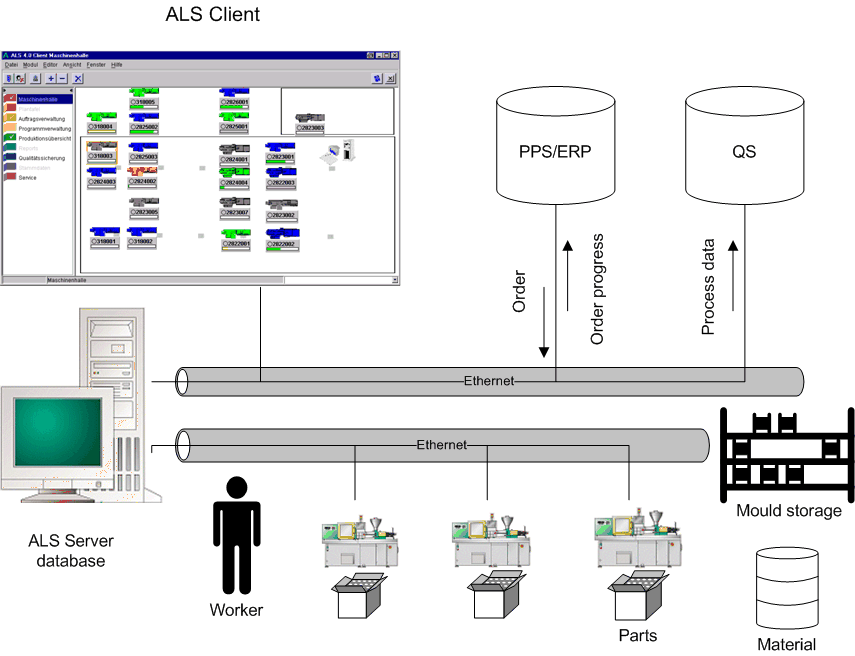
The ARBURG Host Processor System (ALS) has been designed for the following purposes in the production area of plastic injection moulding :
to reduce routine work for the acquisition of production characteristic values
to guarantee and document the basic conditions for process stability,
for transparency of the order through-flow.
The ALS system can be integrated in existing software programs, so that the data acquired in ALS can be used at any time in the flow of operational information. In this way an existing Production Planning System (PPS) or Enterprise Resource Planning System (ERP) receives reliable data for the subsequent calculation and for the progress of the order. Process data are prepared for quality assurance systems such as the ARBURG Quality Assurance System AQS.
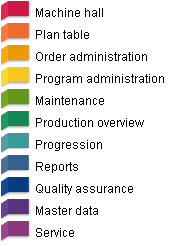 |
The ALS software is broken down into 'modules' in accordance with the various tasks it manages. These modules are identical with those in the 'ALS Client', the graphical user interface of the ALS. The 'ALS Client' makes access to the functionality and data of the ALS possible. The user can arrange the representation of the data in the 'ALS-Client' according to his/her own requirements. The Client can be started on any processor which has a network connection to the ALS-Server. |
The basic modules 'Machine hall' and 'Production overview' provide direct information on what is currently being carried out in the production hall.
In the 'Machine hall' the operating statuses of the connected machines can be seen at a glance on a colour-coded diagram. 'Machine status' contains all current information available on a machine. The status is called up by ALS in cycles. When the operating mode is changed the machines automatically signal the new status to the host processor. Based on the status data, evaluations are available on the machine run times, the degree of efficiency the standstill causes and machine alarms. A shift report provides a complete overview of data on the produced quantities, run times and standstill times.
The 'Production overview' shows which orders are assigned to which machines in tabular form. It also shows the current values on quantities, cavities and cycle time and, bases on these data, the remaining run time.
Detailed information on the production procedure can be found in 'Progression'.
The 'Program administration' module provides all functions which guarantee that always the correct program (machine adjustment data set) in the combination mould, machine and item is transferred to the machine. This in turn guarantees that an item is always manufactured with the same, optimised program.
The 'Maintenance' module offers you support with the scheduling of maintenance work of moulds and machines.
The 'Quality assurance' module provides all functions for the monitoring of the process parameters. You can define which process parameters are to be monitored and specify the tolerance ranges for each machine individually. If a tolerance is exceeded, the quality traffic lights change to red on the symbol of the machine in question. The parameter values are displayed in measured value charts. The acquired values and the inspection order can be made available for an external system, e.g. the ARBURG Quality Assurance System AQS, for further evaluation and archiving.
In the 'Reports' module the evaluations of orders, items and moulds are put together. The data are displayed in tables and diagrams.
The ALS requires data for the administration of the user, machine, tool and item data as well as for the company 'working calendar'. These data are contained in the 'Master data' module.
Special functions, such as the sending of messages between the registered ALS users are collected in the 'Service' module.
Should problems arise with your ALS please contact the 'ARBURG ALS Support' department, e-mail address: 'als_support_germany@arburg.com'.